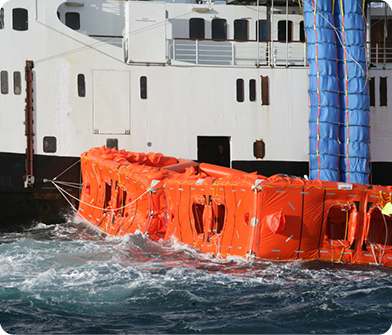
Marine Evacuation Systems (MES)...
...have become a cornerstone of modern passenger ship safety, providing a fast, reliable, and efficient means of evacuating large numbers of people in an emergency. Since their introduction to the market by Survitec more than four decades ago, MES technology has evolved significantly, driven by vessel design, advances in engineering, regulatory requirements, and the maritime industry’s commitment to enhancing passenger safety.
|
|
|
|

2,500+
MES units fitted
|
|
|

800
Vessels worldwide
|
|
|

330+
Service stations worldwide
|
|
|
01 What is a Marine Evacuation System?
A Marine Evacuation System is a fully engineered lifesaving arrangement designed to rapidly transfer passengers and crew safely from a vessel to a liferaft in an emergency. Instead of relying on traditional davit-launched lifeboats, MES systems enable rapid, controlled evacuation through an automatically deployed slide or chute connected to large-capacity inflatable liferafts.
|
How MES works
When activated, an MES deploys over the ship’s side and inflates within minutes, allowing a steady flow of people to board liferafts directly. Modern systems, which are designed to meet the requirements of SOLAS and LSA code, are highly automated, require minimal crew intervention, and are designed to perform safely in rough sea conditions, with MES distinguished by its requirement to pass a Heavy Weather Sea Test to demonstrate this capability. With the ability to evacuate hundreds of people in under 30 minutes, MES delivers a step change in passenger safety.
|
|
|
02
02 A Timeline of Continuous Innovation
The development of MES can be traced back to the inflatable liferaft technologies pioneered in the early 20th century. The breakthrough moment came in 1979, when Survitec’s RFD introduced the first-ever MES for the passenger ferry market. This initial concept, an inclined inflatable slide paired with high-capacity SOLAS liferafts, provided a faster and more efficient alternative to traditional lifeboats. It marked the beginning of a new era in evacuation safety.
|


|
|
1979
The Beginning
Survitec's RFD introduced the first-ever MES for the passenger ferry market. This initial concept, an inclined inflatable slide paired with high-capacity SOLAS liferafts, provided a faster and more efficient alternative to traditional lifeboats.
|
|
|

|
|
1980s and 1990s
Scaling Up
As vessel sizes increased through the so too did the demand for systems capable of supporting more passengers and operating from higher freeboards. This led to the development of longer slides, greater raft capacities, and ultimately, the first vertical chute systems.
|
|
|

|
|
1998
Stockholm Agreement Milestone
In 1998, the approval of the Marin Ark 430P MES represented a significant milestone: the first system to fully comply with the Stockholm Agreement. Its fully reversible liferaft and twin chute were a revolutionary departure from all other MES on the market.
|
|
|

|
|
2000
Enhanced Performance
The 2000s ushered in further advancements as cruise lines and ferry operators sought higher-capacity systems to accommodate larger vessels such as the Marin Ark2 and other industry-leading designs. In response to this need, they delivered enhanced performance, improved automation, and reduced operational risks.
|
|
03 Marin Ark2: World-Leading MES Technology
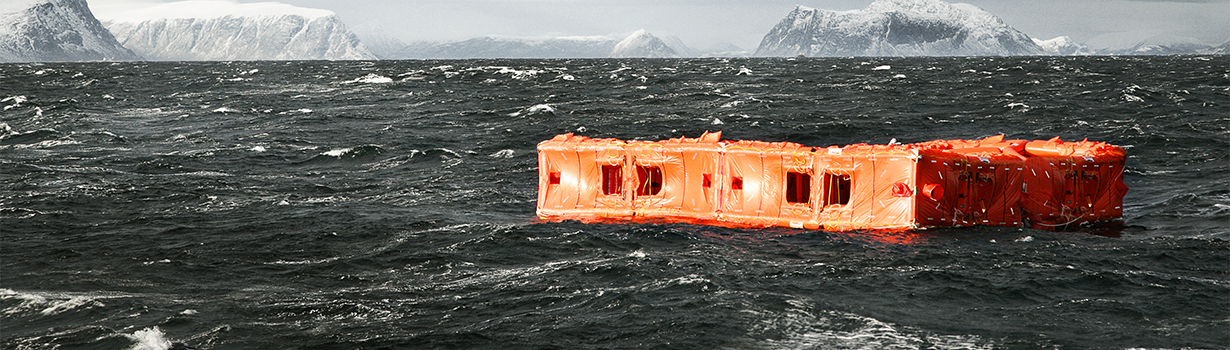
The Marin Ark2 is one of the largest dry-shod MES in the world. Its unique design provides space for 158 passengers and can be expanded to accommodate up to 948 passengers, evacuated into the liferafts via dual helical slides. It enables rapid and safe evacuation of up to 948 passengers in less than 30 minutes. Features include simple crew operations and a robust, fully reversible liferaft, with multiple buoyancy compartments ensuring maximum stability and safety in the most challenging sea conditions.
- Simple crew operation
- Multiple buoyancy compartments
|
- Robust, fully reversible liferaft
- Maximum stability in challenging conditions
|
|
|



 5 minute read