

Fire Equipment
Click here to find out more about our extensive range of fire fighting equipment, fire safety systems & services

Frequently asked questions about fire extinguishers
Frequently asked questions about Fire Safety Systems & Services
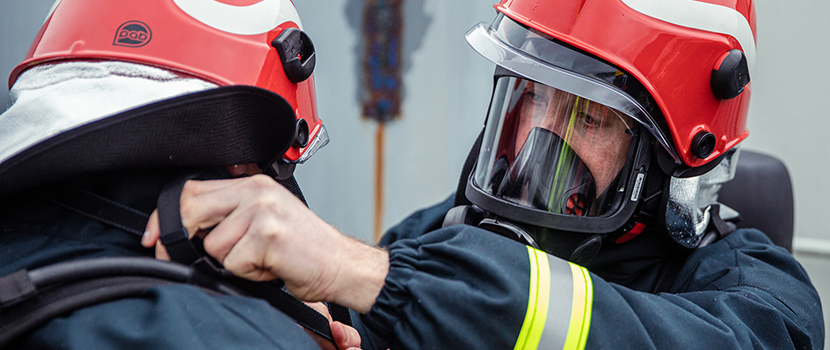
Select tools based on strength, weight, ergonomic design, and task suitability, ensuring reliability under extreme conditions. Choosing firefighting equipment for sea requires strict adherence to international safety regulations to ensure reliability in harsh, saline environments. The primary requirement is that all equipment should be SOLAS (Safety of Life at Sea) compliant and, for European vessels, comply with the Marine Equipment Directive (MED), often identified by the "Ship’s Wheel" mark.
Protective clothing must provide effective protection against:
- Heat and flames
- Water and steam
- Mechanical damage
The clothing must be suitable for firefighting operations on board ships as defined by the FSS Code.
Best in class firefighter PPE offers thermal protection, impact resistance, ergonomic fit, and durability, while meeting accredited safety standards.
SOLAS requires ships to carry firefighter’s outfits consisting of protective clothing and essential firefighting accessories. The exact number depends on vessel type and size, but the equipment is mandatory on almost all SOLAS vessels.
Individual components of the firefighter outfit may require MED approval depending on flag-state requirements. In practice, complete outfits supplied for marine use are accepted by flag states and class when they comply with SOLAS and FSS Code requirements and are provided by recognised manufacturers.
European Maritime Safety Agency (EMSA) recommends classification level 2 for all three criteria (Thermal Performance, Water Penetration Resistance and Breathability/Water Vapor Resistance) for fire suits used in Ro-Ro spaces.
Yes, out FireBuddy Plus 2020 firefighter suit meets the EN469:2020 level 2 standard which is the higher requirement. It includes the minimum requirements for clothing worn during structural firefighting operations.
There is no requirement to withdraw or replace existing firefighter suits compliant with EN469:2005. Firefighter suits compliant with EN469:2005 that were placed onboard before 25th August 2024 are acceptable until they require replacement due to wear and tear.
EMSA recommends wearing a hood (balaclava) to afford extra protection to the head and neck. Such hoods are not (yet) included in MED and can instead be approved according to EN 13911:2017.
A standard marine firefighter’s equipment consists of:
- Firefighter protective clothing (jacket and trousers)
- Firefighter helmet with visor
- Firefighter gloves
- Firefighter boots
- Self-contained breathing apparatus (SCBA)
- Fireproof lifeline with snap hook
- Firefighter axe
- Portable safety lamp (explosion-proof)
All items must be suitable for shipboard firefighting conditions.
SOLAS requires: At least 2 firefighter’s outfits on cargo ships of 1,000 GT and above passenger ships require additional outfits, depending on the design, normally positioned at fire stations. Exact requirements may vary depending on ship type, size, and class rules.
Yes. Marine firefighter outfits are designed for:
- Confined spaces
- Steel structures and ladders
- Shipboard hazards (heat, smoke, oil, water)
- Compatibility with marine SCBA and lifelines
Industrial firefighting gear may not be accepted on ships unless it clearly meets marine regulatory requirements.
Firefighter outfits must be:
- Stored in clearly marked lockers
- Located near fire stations or strategic locations
- Easily accessible during an emergency
They must not be stored inside the engine room unless specifically approved.
Firefighter outfits must be:
- Visually checked regularly by the crew
- Inspected and maintained according to the manufacturer’s instructions
- Kept in a ready-for-use condition at all times
Records of inspections and SCBA servicing must be kept on board.
Yes, provided that:
- Replacement items are suitable for marine use
- They meet the same performance and safety requirements
- The complete outfit remains compliant with SOLAS
Mixing incompatible or non-approved items should be avoided.
Yes. PSC inspectors routinely check:
- Availability and condition of firefighter outfits
- Completeness of equipment
- SCBA condition and cylinder pressure
- Storage and accessibility
Non-compliance may result in deficiencies or detention.
Yes. Each firefighter outfit must include a self-contained breathing apparatus (SCBA) with sufficient air capacity (normally minimum 30 minutes) suitable for firefighting in enclosed shipboard spaces.
Yes. A firefighter axe must be provided and kept ready for immediate use. The axe is a mandatory accessory for shipboard firefighter outfits under SOLAS.
Choose based on risk level, duration, operational role, and mobility requirements, ensuring full compliance with relevant standards. SOLAS (Safety of Life at Sea) mandates strict requirements for Breathing Apparatus (BA) used for firefighting, governed primarily by Chapter II-2 and the Fire Safety Systems (FSS) Code. These regulations require self-contained breathing apparatus (SCBA) to be of an approved open-circuit type, with specific capacity, weight, and safety features for onboard firefighting
An EEBD (Emergency Escape Breathing Device) provides short duration escape air, while SCBA (Self Contained Breathing Apparatus) is designed for full firefighting operations.
SAR (Supplied Air Respirator) provides air via a remote source, while SCBA includes an onboard air cylinder for complete mobility.
Yes. SOLAS requires spare cylinders for SCBA to be provided on board. The number of spare cylinders depends on how many firefighter outfits are carried on the vessel.
The firefighter’s outfit must include a portable electric safety lamp that is:
- Explosion-proof
- Suitable for use in hazardous areas
- Capable of being used in smoke and darkness